The SAP Business AI Platform Is Not a Single Product
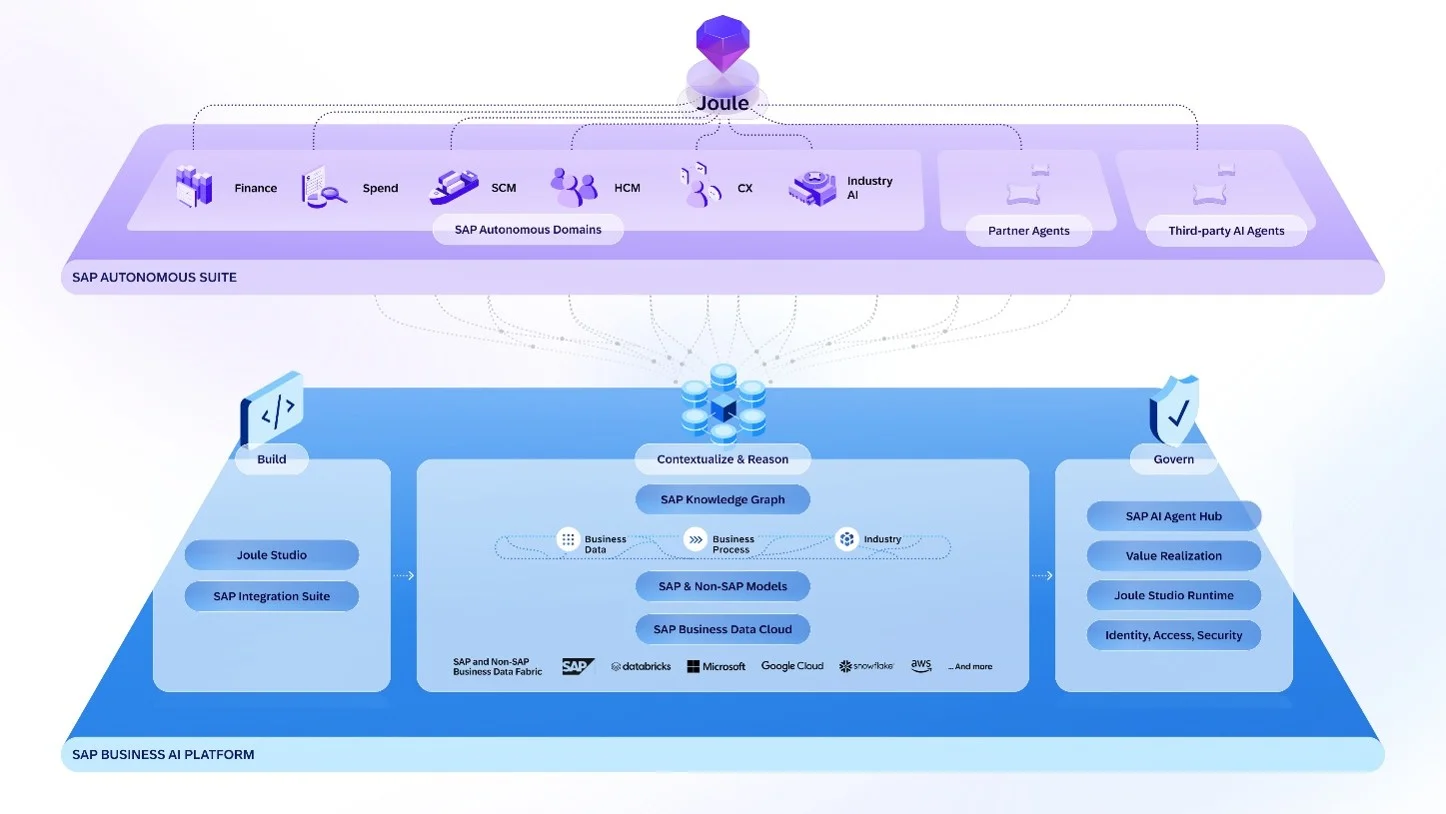
First, an important distinction must be made: the SAP Business AI Platform is not a single new product that simply replaces SAP BTP. Instead, SAP is bringing together a range of platform capabilities that have been developed over many years into a unified technological and strategic framework. These include:
- the established services of the former SAP Business Technology Platform as the development, extension and integration layer
- the SAP Business Data Cloud as the data and context layer
- the SAP AI Foundation as the basis for AI models, Business AI and agent management
Together, these components are intended to enable organisations to connect applications, data, processes and intelligent agents and manage them across the enterprise. In simplified terms, three core layers form the foundation:
1. Build: Develop, Extend and Integrate
The existing services of the former SAP BTP remain the technological foundation for applications, integrations and extensions. With capabilities such as Joule Studio and the SAP Integration Suite, organisations can develop applications, workflows and AI agents, connect them with existing systems and integrate them across complex SAP and non-SAP landscapes. Traditional BTP scenarios therefore remain highly relevant. Side-by-side extensions, customer portals, bespoke applications and integrations continue to be core elements. They are now viewed more explicitly as part of a broader Business AI architecture.
2. Contextualise & Reason: Translate Data into Business Context
AI requires data. But data alone is not enough. To produce reliable outcomes, intelligent systems need data that is current, consistent and interpretable within a business context. The SAP Business Data Cloud is designed to combine SAP and non-SAP data and make it available as contextualised data products. The SAP Knowledge Graph plays a particularly important role. It is intended to represent relationships between business objects, processes and data on a semantic level. An agent needs more than access to a data record. It must understand whether that record represents a customer, an order, a complaint or a supplier, and how those entities relate to one another within a business process.
3. Govern: Deliver and Control Intelligence
The third layer covers the actual AI capabilities. These include access to different models, SAP-developed models, the Generative AI Hub, the SAP Knowledge Graph and capabilities for managing and governing AI agents. The SAP AI Agent Hub is designed to improve control over an expanding agent landscape. Organisations need visibility into which agents are being used, which systems and data they access, how they are utilised and what costs they generate. Together, "Build", "Contextualise & Reason" and "Govern" create a platform model that enables organisations to develop solutions, enrich them with business context and operate them within a consistent governance framework.
This Is Not About More AI Tools
When discussing the Business AI Platform, SAP talks extensively about Joule, agents and the autonomous enterprise. This can easily create the impression that organisations simply need to introduce as many AI capabilities as possible. That would be the wrong conclusion. Today’s biggest challenge is rarely gaining access to a language model or an AI tool. Such technologies are widely available. The real challenge is embedding AI meaningfully into business processes, enriching it with relevant enterprise data and enabling it to operate reliably across system boundaries. For example, a sales agent requires far more than a generic summary of customer information. It needs access to current opportunities, orders, interactions and potentially service cases. At the same time, it must respect authorisations, process rules and business context. Similarly, a service agent can only provide effective support if it can bring together products, installed assets, contracts, spare parts, service histories and responsibilities within a consistent context. The same principle applies to both scenarios: an agent is only as good as the data, processes and integrations it can access. The SAP Business AI Platform is therefore not primarily a collection of additional AI tools. It is an attempt to establish a robust foundation for enterprise-wide AI adoption.
The Most Significant Shift Is from Applications to Use Cases
For many years, digital transformation initiatives began with the selection of an application. Organisations implemented a new sales, service, commerce or marketing solution and then designed processes around it. That approach is not disappearing. Applications remain an essential part of the IT landscape. However, the starting point is changing. Businesses do not simply want a new sales application. They want to identify opportunities earlier, accelerate quotation processes or standardise global sales operations. They do not only want a service platform. They want to resolve enquiries faster, improve workforce scheduling, make knowledge more accessible and reduce downtime. Nor do they simply need “more AI”. They want to automate specific tasks, improve decision-making and free employees from repetitive manual work. As a result, a layer that has traditionally sat between business and technology is becoming the focal point: business processes and use cases. This development is far more significant than a platform name change. It is changing how investments are evaluated, how solutions are designed and how transformation programmes are managed.
Applications Remain Important, but They Are No Longer Enough
Within the SAP ecosystem in particular, it is tempting to view Business AI as simply another product layer. Additional features are activated, an assistant is added and the expectation is that intelligent business processes will emerge automatically. In practice, that is rarely sufficient. Many high-value use cases extend beyond the boundaries of individual applications. A service agent may require information from CRM, ERP, product databases and knowledge systems. An automated sales process may depend on data from sales, commerce, marketing and external sources. A customer portal often combines multiple backend systems with bespoke extensions and its own user experience. This leads to a clear conclusion: The future does not belong to a single intelligent application. It belongs to intelligently orchestrated processes that span applications and systems. This is precisely why the integration, data, extension and governance capabilities of the SAP Business AI Platform matter. The platform is designed not merely to enrich individual applications with AI, but to provide a common foundation on which applications and agents can work together.
Enterprise Architecture Becomes a Critical Success Factor for Business AI
The more organisations explore AI agents, the more apparent the importance of the underlying architecture becomes. An agent layer alone is not enough. Organisations also require:
- an integration architecture that connects multiple systems
- a data architecture that provides current and contextualised information
- an extension architecture that supports specific business requirements
- a security and authorisation framework
- governance for models, agents and interfaces
- transparency regarding usage, quality, costs and business impact
These components are not independent of one another. When implemented in isolation, they create technical debt, redundant integrations and difficult-to-manage point solutions. In the worst case, organisations invest heavily in a large number of AI pilots, consume significant computing and model resources, yet generate little practical value. The consequences go beyond financial cost. Poor or inconsistent outcomes can also undermine employee trust in AI solutions. For this reason, organisations should already be reviewing their underlying architecture and the interaction between agents, data, extensions and integration. Not because of concern over the latest SAP announcements, but to ensure that future AI and agent-based scenarios are built on a sustainable foundation.
What Organisations Should Do Now
The new SAP Business AI Platform does not require the immediate replacement of existing systems. Nor is it a reason to question ongoing BTP, integration or extension initiatives. In fact, many existing investments form an important part of the future foundation, especially robust integrations, contextualised data, side-by-side extensions and clean-core-compliant architectures. Organisations should now focus on answering four key questions:
- Which business processes offer meaningful potential for AI, automation or agents?
- Which data and business context are required?
- How should applications, integrations and extensions work together?
- How can quality, security, cost and business value be governed over time?
The right starting point is therefore not selecting a specific tool. It begins with use cases and business objectives. Only once it is clear what problem needs to be solved and what measurable value should be achieved does it make sense to determine which capabilities of the SAP Business AI Platform are required.
The SYBIT Perspective: Use Case over Tool
From our perspective, the greatest significance of the SAP Business AI Platform is not the new product name. It is the validation of a necessary shift in mindset. Organisations must approach digital transformation through three interconnected perspectives:
- the applications that provide functionality
- the processes and use cases that generate business value
- the enterprise architecture that brings together data, integration, extensions and AI
None of these layers can succeed independently. Those who focus only on applications overlook cross-functional processes. Those who implement isolated use cases without a solid architecture create silos. And those who build a technology platform without clear business objectives risk investing in capabilities that deliver little practical value.
Conclusion: More Than Just a New Name
The SAP Business AI Platform is not an entirely new standalone product. Nor is it simply SAP BTP with additional AI branding. It represents a broader platform vision in which applications, enterprise data, business context, integrations, AI models and agents are no longer viewed separately. Whether SAP ultimately delivers every announced capability exactly as presented today remains to be seen. What matters is the strategic direction. Enterprise software is evolving from a world of individual applications to one of connected, data-driven and increasingly agent-enabled business processes. As a result, enterprise architecture becomes the prerequisite for Business AI to operate reliably and generate measurable value.