
From scattered data to sound decisions
AI automation and modern analytics are only as good as the data on which they are based. Many companies have enormous volumes of data in CRM, commerce, service, ERP, data warehouses, Excel spreadsheets or free-text fields. However, this data is often inconsistent, inaccessible or difficult to interpret unambiguously.
The result:
- Reports contradict one another
- Departments are debating the figures
- AI use cases remain theoretical
- Valuable process knowledge cannot be utilised on a scalable basis
This is exactly where SYBIT comes in.
With Phaise 0, we work with you to develop your roadmap for data quality, data products, analytics and AI capability.

Without a data strategy, AI remains an experiment
Many companies start using AI tools before their data infrastructure has been clarified. This quickly leads to typical problems:
- Data is stored in silos and is not interconnected.
- Customer data, product data and process data follow different logics.
- Business units use their own definitions and reports.
- Data quality is only noticed when an AI use case fails.
- Analytics remains a form of retrospective reporting rather than a basis for operational decision-making.
It is therefore clear to us that:
Use cases and the data foundation go hand in hand.
Anyone wishing to use AI, automation or analytics successfully does not simply need more data. Companies need data that is usable, reliable and understood from a business perspective.

What are data products?
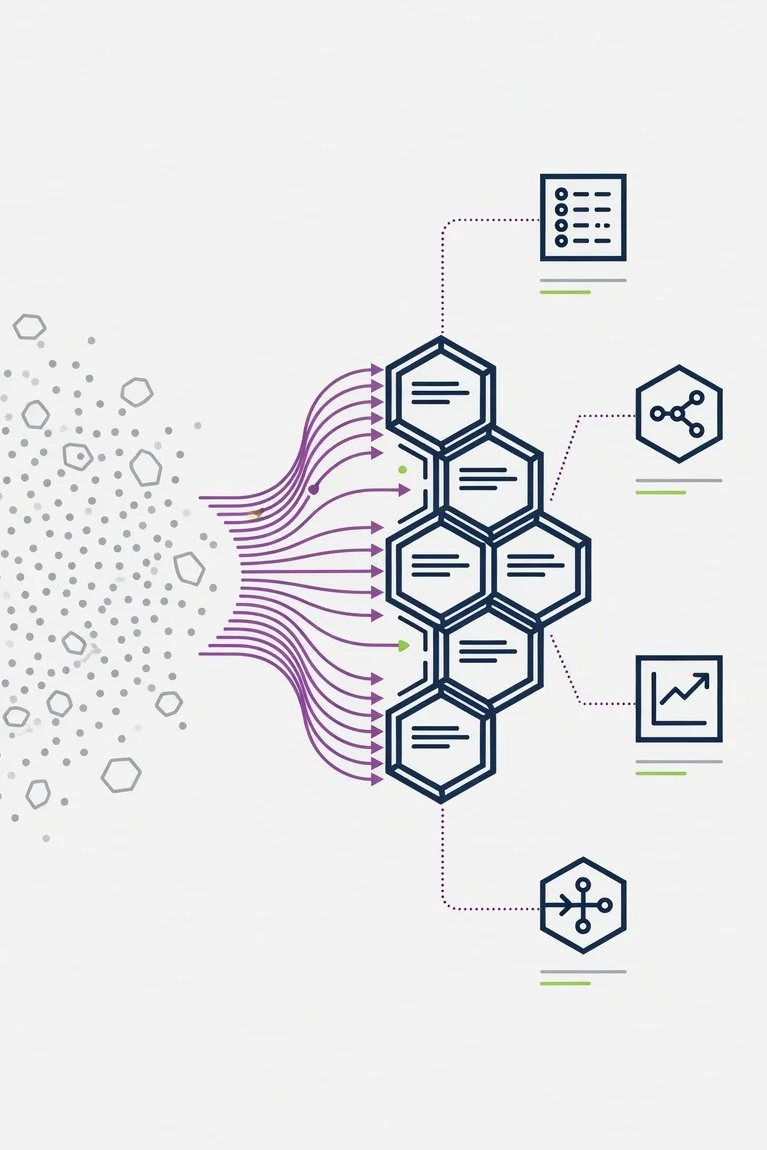
Data products make data usable for people, systems and AI. They are curated, quality-assured data building blocks with a clear purpose, unambiguous meaning and defined interfaces.
Instead of accessing raw data, which each department interprets differently, reliable data products are created, such as:
- Customer 360 View for a unified view of the customer
- Demand Signals for demand and market indicators
- Customer Risk Features for churn or escalation risks
- Product Configuration Data for complex quotation and configuration processes
- Service Interaction Data for better prioritisation and next-best actions
A good data product doesn’t just answer the question:
‘What data do we have?’
But above all:
‘Which decision or process will this improve?’
Why data products are key to AI and analytics
Data products provide a reliable foundation for everything that is intended to be data-driven: dashboards, forecasts, AI agents, next-best actions, automation and strategic decisions.
You can help by:
- Consistently integrating data from various sources
- clearly documenting business logic,
- making data quality measurable
- defining access rights and responsibilities
- creating reusable data modules for multiple use cases
- providing AI models and analytics solutions with reliable inputs.
This is how scattered raw data is transformed into an active corporate asset.
Ready to use reliable data as the foundation for your AI success?
In a joint workshop, we will work with you to develop a concrete roadmap for your data quality, data products, analytics and AI capabilities — tailored to your system landscape and use cases.
Leave scattered data and conflicting reports behind and lay the foundations for truly robust AI, automation and analytics solutions.

Analytics: From monthly reports to a decision-making platform
Analytics has long since become more than just retrospective reporting. Modern analytics supports decision-making right where decisions are made: in sales meetings, in service processes, in commerce management or in strategic planning.
Expectations are changing:
| In the past | Today |
|---|---|
| Monthly report | Live dashboards |
| historical analysis | Forecasts and recommendations for action |
| IT-driven reporting | Self-Service Analytics |
| Isolated KPIs | Integrated decision logic |
| Report via email | Embedded insights within the process |
True value is created when operational data, customer data and analytical models work together. This is when reports are turned into concrete recommendations:
- Which customers are at increased risk of churn?
- Which sales opportunities should be prioritised?
- Which service cases require immediate attention?
- Which product combinations are frequently requested together?
- Which e-commerce metrics indicate conversion issues?
This is how analytics becomes an active part of the customer experience.
Data in practice: Three use cases that create business value
The following examples illustrate how data products and analytics can improve specific CX processes – not as an abstract data initiative, but as the foundation for measurable results in sales, commerce and service.

-
1. Customer 360 Data Product: A view of the customer
Many companies hold customer data in CRM, ERP, commerce, marketing automation and service systems. However, if this data is not linked, it is not possible to form a complete picture of the customer.
A Customer 360 Data Product brings together relevant customer information and makes it available in a consistent format, for example for sales, service, marketing, analytics or AI agents.
It can collate information such as:
- Master data
- Purchase history
- Service cases
Contract data - Interaction data
- Quotation and opportunity data
- Digital touchpoints
Business Value:
Better customer engagement, more informed decisions, fewer debates about data, and a robust foundation for next-best actions. -
2. Sales & Demand Analytics: Identifying growth potential at an earlier stage
Sales teams need to know where the real potential lies: Which customers are buying less than expected? Which product groups are growing rapidly? Which leads or opportunities deserve priority?
Sales & Demand Analytics processes existing sales, commerce and ERP data in such a way that signals of growth become apparent.
Possible areas of application:
- Identify cross-selling and upselling opportunities
- Identify changes in demand
- Assess the likelihood of making an offer and closing a deal
- Improve forecasts
- Set sales priorities based on data
Business Value: Greater transparency in sales, better prioritisation, a higher probability of closing deals and more targeted growth management.
-
3. Service Intelligence: Data-driven decision-making in customer service
Valuable data is generated every day in the service department: tickets, fault reports, feedback, spare parts requirements, processing times, escalations and customer satisfaction.
A structured Service Intelligence Data Product makes this information usable for analytics, automation and AI-powered recommendations.
This makes it possible for example to:
- Early detection of critical cases
- Improved prioritisation of tickets
- Analysis of recurring faults
- Data-driven resource planning
- Next-best actions in the service process
- Improved management of service quality and SLA compliance
Business Value: Faster response times, higher service quality, better capacity utilisation and greater transparency regarding recurring causes.
What these use cases have in common
Whether it’s Customer 360, Sales Analytics or Service Intelligence: the value does not come from a single dashboard. It arises from the interplay between business questions, the data model, technical architecture and governance.
That’s why we don’t start by asking:
“Which analytics tool do you need?”
But rather with the question:
“Which decisions do you want to make better – and what data do you need to do so?”

Our approach: Business-driven. Architecture-ready.
Data initiatives often fail when they are approached from too technical a perspective. That is why, at SYBIT, we combine a deep understanding of business processes with data architecture, analytics expertise and CX consultancy. In short: data projects must start with business value.
Our approach follows five clear steps:
1. Define business objectives and use cases
We start with the decisions you want to improve. From these, we derive specific use cases, such as better forecasts, lower churn, more efficient service processes or higher conversion rates in e-commerce.
Each use case is linked to a specific objective or KPI. This ensures that analytics is not an end in itself.
2. Understanding the data landscape
We analyse what data is available, where it is located and how it is used. In doing so, we consider not only systems, but also technical definitions, responsibilities and process logic.
Typical questions:
- Which data sources are relevant?
- Where are there duplicates or inconsistencies?
- What data is missing for the use case?
- Which technical definitions need to be harmonised?
- Where is implicit knowledge hidden in free-text fields, Excel lists or experts’ minds?
3. Modelling data products
Structured data products are created from the relevant data. In doing so, we define their business significance, quality rules, responsibilities, interfaces and usage scenarios.
In this way, data becomes not only technically accessible, but also useful from a business perspective.
4. Establishing architecture and governance
We develop a vision for your data and analytics architecture: modular, integrable and scalable.
This includes:
- Data integration
- Data platforms
- Interfaces and APIs
- Data catalogues
- Roles and responsibilities
- Quality rules
- Monitoring
- Access policies
- Governance structures
The aim: an architecture that supports today’s use cases and prepares for future AI scenarios.
5. Embed analytics with a user-centred approach
Data only creates value when people actually use it to make decisions. That is why we factor in adoption, enablement and work processes right from the start.
- We provide support in:
- Developing dashboards in collaboration with business units
- Smoothly introducing self-service analytics
- Integrating key performance indicators into meetings and decision-making processes
- Empowering teams to work with data
- Embedding data-driven routines into day-to-day work
In this way, data becomes an integral part of operational management.
Why go to all this trouble with the data?
A well-designed data product makes implicit knowledge explicitly usable. A telling example from one of our data & AI projects: a mechanical engineering firm had countless possible variations of its products, but the configuration know-how was held solely by a handful of experts. This meant that thousands of historical configuration records were lying dormant. We helped to translate this knowledge into digital rules and data. The result was a hybrid data product: a ‘configuration assistant’ that combines expert rules with statistical probabilities derived from past orders.
New product configurations are now suggested, in some cases automatically, and every completed order is immediately fed back into the data product as a learning point. Important: The experts remain in the driver’s seat and can adapt or override suggestions. Through this data product, the company has preserved generations of knowledge, activated its ‘data portfolio’ and created a reusable treasure trove of data that will also be available for future use cases.

Data Products: The One Voice of Truth
Data products therefore help to turn isolated data points into reliable insights. When your AI (or your BI tool, or your marketing team) has a question, a data product can act as a single source of truth – having evolved alongside your process data, consistent across departments and inspiring confidence through
documented origin. This not only reduces misjudgements but also saves a huge amount of time: less searching, less discussion about differing figures – and instead, you can get straight down to analysing and making decisions.
Clarity, a vision and a roadmap in just a few weeks
PhAIse 0: Your bespoke data strategy
PhAIse 0 is a structured starting point for companies wishing to improve their data infrastructure in a targeted manner and make it usable for analytics, AI and automation.
Together, we assess your current situation, identify relevant use cases and develop a vision for your data and analytics landscape.
The result is a robust basis for decision-making regarding your next steps.
What you’ll take away from PhAIse 0
- Status and Maturity Assessment
You will gain clarity on where you stand today: technologically, organisationally and functionally. - Prioritised Data & AI Use Cases
We identify specific use cases and evaluate them in terms of business value, feasibility and data availability. - Data Product Vision
You will know which data products should be developed for your most important use cases. - Architecture Blueprint
You will receive an initial vision for data integration, platform, analytics, governance and AI capability. - Roadmap with Quick Wins
You will receive specific recommendations for initial measures and medium-term implementation steps. - Basis for Investment Decisions
You will be able to make more informed internal arguments about which data initiatives should be prioritised and what business value they create.
Who is PhAIse 0 relevant for?
PhAIse 0 is particularly suitable for companies that …
- want to improve their data quality and data availability
- wish to prepare AI use cases
- want to move analytics beyond reporting
- wish to create a robust foundation for self-service analytics
- want to better integrate data from CRM, commerce, service and ERP
- wish to build data products
- want to structure governance and responsibilities more clearly
- need a well-founded roadmap before making major data and AI investments
What is assessed during a preliminary interview?
During a no-obligation initial consultation, we will work through the following together:
- Where do you currently stand in terms of data quality, analytics and AI capability?
- Which use cases might be relevant to your business?
- Which data sources and systems play a key role?
- Whether Phaise 0 is the right starting point for your situation
- What the next steps should be
Use PhAIse 0 to turn scattered data into a robust foundation for analytics, AI and better decision-making.

PhAIse 0: Your strategic introduction to AI
Discover our PhAIse-0 packages and find the right starting point for your data and AI initiative. From identifying relevant use cases, through data and architecture assessments, to a proof of concept, you’ll receive a clear and predictable path to measurable business impact. Still unsure which package suits your situation? We’d be happy to advise you personally.
Mail: sales@sybit.de
Tel.: +44 7348948903